
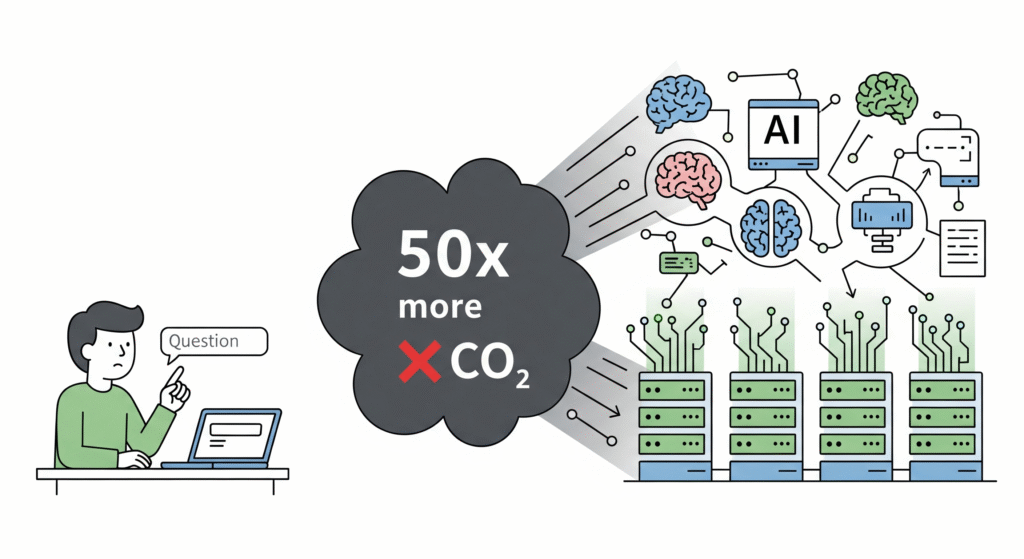
Every time we ask AI a question, it doesn’t just return an answer — it also consumes energy and emits carbon dioxide (CO₂).
German researchers discovered that some “thinking” AI models, which generate long step-by-step reasoning before answering, can emit up to 50 times more CO₂ than models providing short, direct answers. These emissions do not always result in better responses.
AI Responses Have a Hidden Environmental Cost
Whatever question you ask AI, it will always generate a response. To do this, whether the answer is accurate or not, the system uses tokens. These tokens consist of words or word fragments converted into numerical data for processing by the AI model.
This process, along with broader computation, leads to carbon dioxide (CO₂) emissions. However, most people are unaware that using AI tools leaves a significant carbon footprint. To better understand this impact, researchers from Germany analyzed and compared the emissions of several pre-trained large language models (LLMs) using a sequential set of questions.
“The environmental impact of querying trained LLMs is largely determined by their reasoning approach, as explicit reasoning processes significantly increase energy consumption and carbon emissions,” said first author Maximilian Downer, a researcher at Munich University of Applied Sciences and the first author of the study published in Frontiers in Communication. “We found that reasoning-based models generate up to 50 times more CO₂ emissions than models providing concise answers.”
Reasoning Models Burn More Carbon, But Not Always for Better Answers
The team tested 14 different LLM programs, each containing 7 to 72 billion parameters, using 1,000 standardized questions on various topics. Parameters determine how the model learns and makes decisions.
On average, reasoning-based models generated 543.5 additional “thinking” tokens per question, while short-answer models generated only 37.7 tokens. These thinking tokens represent extra internal content generated by the model before producing the final answer. More tokens always mean higher CO₂ emissions, but this does not always translate into better results. Extra detail may not improve answer accuracy, while increasing ecological costs.
Accuracy vs. Sustainability: A New AI Trade-Off
The most accurate model was Cogito, a reasoning-based model with 70 billion parameters achieving 84.9% accuracy. This model produced three times more CO₂ emissions than similarly sized models providing short answers. “Currently, we see an explicit trade-off between accuracy and sustainability inherent in LLM technologies,” said Downer. “None of the models keeping emissions below 500 grams CO₂ equivalent achieved more than 80% accuracy when answering 1,000 questions.” CO₂ equivalent is a unit measuring the climate impact of various greenhouse gases.
Subjects studied also varied significantly in CO₂ emissions. Questions requiring long reasoning, such as abstract algebra or philosophy, produced six times higher emissions than simpler subjects like high school history.
Making Prompts Smarter (and More Eco-Friendly)
Researchers hope their work will help people make more informed decisions about AI use. “Users can significantly reduce emissions by prompting AI to generate concise answers or by limiting high-performance models to tasks that truly require that power,” noted Downer.
For example, model choice can substantially affect CO₂ emissions. If DeepSeek R1 (70 billion parameters) answers 600,000 questions, CO₂ emissions are comparable to a round-trip flight from London to New York. Meanwhile, Qwen 2.5 (72 billion parameters) can answer more than three times as many questions (about 1.9 million) with similar accuracy while generating the same emissions.
Researchers noted that results may be influenced by hardware choice, emission factors that vary by region and energy grid composition, and the specific models examined. These factors may limit generalizability.
“If users know the exact amount of CO₂ emissions generated by AI activities, such as turning oneself into a toy, they can approach when and how to use these technologies more selectively and thoughtfully,” concluded Downer.
Reference: “Energy Costs of Communicating with Artificial Intelligence” by Maximilian Downer and Gudrun Socher, April 30, 2025, Frontiers in Communication.
DOI: 10.3389/fcomm.2025.1572947
Если готов, дай команду ‘продолжай’, и я переведу статью на французский.